
3 Trends Today From Yesterday

Just a massive thank you to the sweet response (and comments!) to yesterday’s post on The Story of The Fashion Folks and me. You’re all so sweet and I blush. Will keep the personal posts more regularly as you seemed to appreciate it! Anyways, catch today’s post below!


Folks, you’re a smart bunch of people. I know you are. So many of you have been commenting on the similarities between past and present fashion on the #throwback posts! Which couldn’t be more true, the fashion today is a product of the fashion yesterday. As we move along, it always feels like we’re looking back at past trends, which we do. Beyond that though, we are still managing to create new looks and styles with the old elements. With that said, here are 3 trends today from yesterday. (and yes, please do give me some cred for the title, quite subtle and brilliant, lol).

Velvet

Even though velvet for long has been a fabric of nobility and aristocracy, I’m pretty sure it’s never gotten the attention of today (or this fall). Velvet is everywhere and people love it! I’ve written about its history in this post, but a reminder never hurts. Velvet emerged in the 8th century and has since been a popular material for the highly privileged. This due to the high cost to produce, but also due to the glam feeling of the material. If you’ve touched velvet, you know that it’s quite heavy yet soft at the same time. Especially during the Medieval period was it popular, with both men and women working it. The association with privilege and the fabric, has remained through history with some chic features (hello to the chokers of the 19th century). Also the glam life of the 1920s did velvet and so did the 1970s.

Modern Velvet Trends

Perhaps around this time (the 1970s), the fabric started to become more relatable and a piece for the everyday person. This was definite in the 1990s when street style fashion embraced the fabric. With our new found love for the 1990s fashion, velvet is hotter than ever. Not as long and heavy dresses though, like 500 years ago, but in every way imaginable. They are even popular as something so unpractical as shoes, but not to blame, they are painfully chic! The way we use and love the fabric is similar to how it was done 20 years ago. With a mix of slip dresses, pants, chokers and skirts! So your newly bought velvet top is kind of 20 years old.

I’ve always said that fashion is democratic. If the history of velvet doesn’t show it, I’m not sure what does. Taking a fabric that’s been exclusive to money and privilege and making it an item of street wear is something. Even though it took a couple of hundred years, lol!

Statement Sleeves

Alike velvet, the statement sleeves are anything but new. In fact, the lack of statement sleeves in the past 100 years of fashion, has been an exception to history’s love for the sleeves. Especially during the Renaissance the sleeves were of great impact. They didn’t settle for only one popular style, but several. One of them were the Paned sleeves. The Paned sleeves consisted of two layers of fabric, where the fabric underneath was puffed out of the top fabric in the slits. Another trend was the Hanging sleeve. Where the fabric had an opening by the elbow, and the sleeves continued down the hips or even longer. Kind of like a cape meeting a coat, but the opening for the arms is not on the body but on the arms (making so much sense right now).

picture source (creative commons)

Some More Sleeves

But thus the fancy sleeves of the Renaissance, our statement sleeves today are more similar to the fashion of the 18th- and 19th century. For instance the Gigot sleeve, or Ham sleeve, is kind of trendy today. Perhaps not to the same oversized dimension, but the resemblance is there. The Gigot sleeve sort of looks like as if you’d have a balloon in the sleeves of your upper arms. They are wide and puffy at the same time. Another stylish sleeve from the 19th century, that’s definitely back in fashion today, is the Pagoda sleeve. The Pagoda sleeve is narrow by the shoulders and gets wider towards the wrist. To give you a better image; kind of like a cone.

One of the sleeves that are popular today is the Bell sleeves. They were popular in the 1970s and early 2000s too. However, they are quite the subtle ones in comparison to what sleeves have looked like through history. Yet, what comes around goes around!

Pyjama trend

This post is already going longer than it should, but let me be quick on this one. When the pyjama trend first began to grow, people outside the fashion world had a hard time grasping it. Wearing pyjama is something one wears in private and often in the bedroom. So even though we’re living in a society where nudity and sexual awareness is highly present, there are still fashion boundaries people obey. As the pyjama trend grew bigger, and became more stylish (and now exists in a fine balance of luxurious office wear and comfy life), people are more and more accepting it.

18th Century Pyjama Party

The specific pyjama trend with a flannel shirt and matching pants might not have a proper counterpart in history, as the style is not that old. However, the idea of wearing pyjama, or underwear, in public has several counterparts. One of them is the 18th century and Marie Antoinette (see pic below). As a reaction to the french people’s outrage with her endless splurging on clothes, she started to embrace a more simple fashion. Away with the panier, the uncomfortable bodice and heavy skirts and hello to the muslin dress. The muslin dress was often white, made of very sheer fabric and kind of looked like the underwear of the 18th century. She wore this in her mini-farm in Versaille and could almost be mistaken for a farmer girl. If the french were happy? Nope, her fashion choice was scandalous and “a queen should not dress like that”.

There are several other times too, where the pyjama life have made people gone mad. More on that on another occasion though. I’ll leave you with the insight that fashion returns over and over again. Depending on the societal perspective of our time, we interpret and wear trends in different shapes. Our idea of past fashion today, is highly glamorized and we have truly taken the chocolate chips out of the cookie!

Folks, that were 3 trends today from yesterday. Hope you enjoyed the post, drop a comment below and tell me what you think! Xx

The History Of The A-line Dress

Is it just us or doesn’t it always feel like Thursday and it’s time for a #throwback? Well, not that we mind it, in fact we do love our dose of history, but too many Thursdays and not enough Saturdays! Well, Thursdays don’t keep us from talking about the fun party (sort of) of the A-line dress!

The story behind the A-line dress

In 1947 Christian Dior launched his collection The New Look. It was a major step back for women’s fashion (in relation to its political power) as it required corsets, heavy skirts and came with limited mobility. From wearing pants during the war years, women were now directed to the old role of looking good and taking care of the house. The collection set the tone for the fashion of the 1950’s, with the hourglass-figure in center. However, in 1955 Dior changed the fashion game again by a new silhouette for a more modern, youthful and liberal shape; the A-line. It wasn’t until 1958 though until Yves Saint Laurent (Christian Dior’s successor) launched a full collection consisting of A-line dresses.

The style of the A-line dress

As the name reveals, the A-line dress is in shape of an A. There are however two versions of the A-silhouette. Some people think of it as tight by the shoulders down to the hips and then moving outwards. Other also include its defined style by the shoulders and moving outwards directly. Both of the styles are in the shape of an A-line and have kind of the same effect, so both are more than okay to use! The typical length is somewhere mid-thigh, but longer and shorter lengths are also A-line as it is about the silhouette and not length.


The legacy of the A-line dress

If you know your fashion history you’re familiar with the style of the 1960’s. It was the A-line silhouette and then there were more A-line silhouettes. Dresses, skirts and tunics all got their adjustments to the 1960’s style. And the timing of the silhouette was impeccable as youths wanted their own fashion of the decade and not dress conservatively as their parents. The dress was easy to move in, dance in and pretty much live in. Gone was the heavy skirts, the annoying corsets and the pretty blouses. The A-line dress was youthful and became even more lively in combination with the crazy patterns of the 60’s. The silhouette also found its way to the space age fashion and was popular in minimalistic colors and styles as well.

The A-line dress today

Today the A-line dress is a staple for many people. The silhouette works for almost anyone as it covers the body, but in a flattering way. As it is a classic and never really goes out of style (even though it always gets extra trendy when true retro fashion is in style), you can pretty much find it in any store and there are endless of options with all the patterns, details and colors of today. Frankly speaking, we love this silhouette for big meals, it has plenty of room for a food baby!

Folks, do you work the A-line dress?

The Foundations Of Foundation

If you stop and think about it, foundation (or makeup in general tbh) is a weird thing. Applying a skin colored cream on your face because your natural skin tone isn’t… good enough? Well nevertheless, we humans have done weirder things in the past and as with all beauty things, we didn’t invent the idea of perfected skin either. Folks, these are the foundations of foundation:

History of foundation

The history of foundation goes back to ancient Egypt, and the use of the cream have pretty much been consistent ever since. Depending on the current beauty trend the art of perfecting have slightly differed. For most of history though, it’s been about making the face look more pale. Pale skin used to be a sign of wealth as one didn’t have to be out working in the sun all day. Through the Middle Ages everything from lemon juice to chalk and white lead were used to achieve a pale look. Even the Victorian ladies used dangerous methods to attain a pale look. In early 20th century The Foundations Of Foundationhowever, makeup guru Max Factor launched pan-cake makeup. It was the first commercially sold foundation with a liquid and powder function in one. The foundation’s popularity slowly increased and by mid 20th century, it was a makeup go-to.

Foundation today

Today, foundation is still a basic product for makeup users world wide. Foundations are even claimed as one of the essentials for a natural makeup look, even though it’s “covering” the face. The foundation of today is mostly aimed at matching the own skin tone and correct skin differences. This is not completely unproblematic though as there are endless of different skin colors, and beauty brands can’t possibly match them all. Another problem is that foundations are more developed, as well as produced, for lighter skin tones which is somewhat rooted in society’s admiration for brighter skin. Terrible, distasteful and in need of a change.

Use of foundation

There are many ways and different levels one can use foundation on. Either you do it just the way it is or you’ll do primer, foundation and finishing powder. Foundation can be applied by fingers, brush, a sponge (read about makeup sponges here), or by airbrush. As there’s a problem with the different shades of foundation and the endless of skintones, it’s common to mix different foundations to get the perfect hue. Another thing that has popped up in the market are correctors, these make the foundation lighter or darker.

Some final notes

We love that there are tools out there for the beauty life, but we’re fully aware of the problematic structure foundation enhances. Not only that our skin in their natural shape is not good enough, but also the lack of diversity in the shades that are offered. It took us over thousand years to attain an ideal wear foundation should match the original skin tone. Let’s hope it won’t take another thousand years to get the beauty industry to embrace diversity.

Folks, what are your thoughts on the foundations of foundation?

The Makeup Of The 1990s

So we like to stay updated on trends, on what the cool kids (sort of) are up to. And as some of you already know, the 1990s are back in fashion. We’ve mostly pinned down the fashion life, but the makeup of the 1990s is having its time in the spotlight too!

the makeup of the 1990s

Essentials for a 1990s makeup look

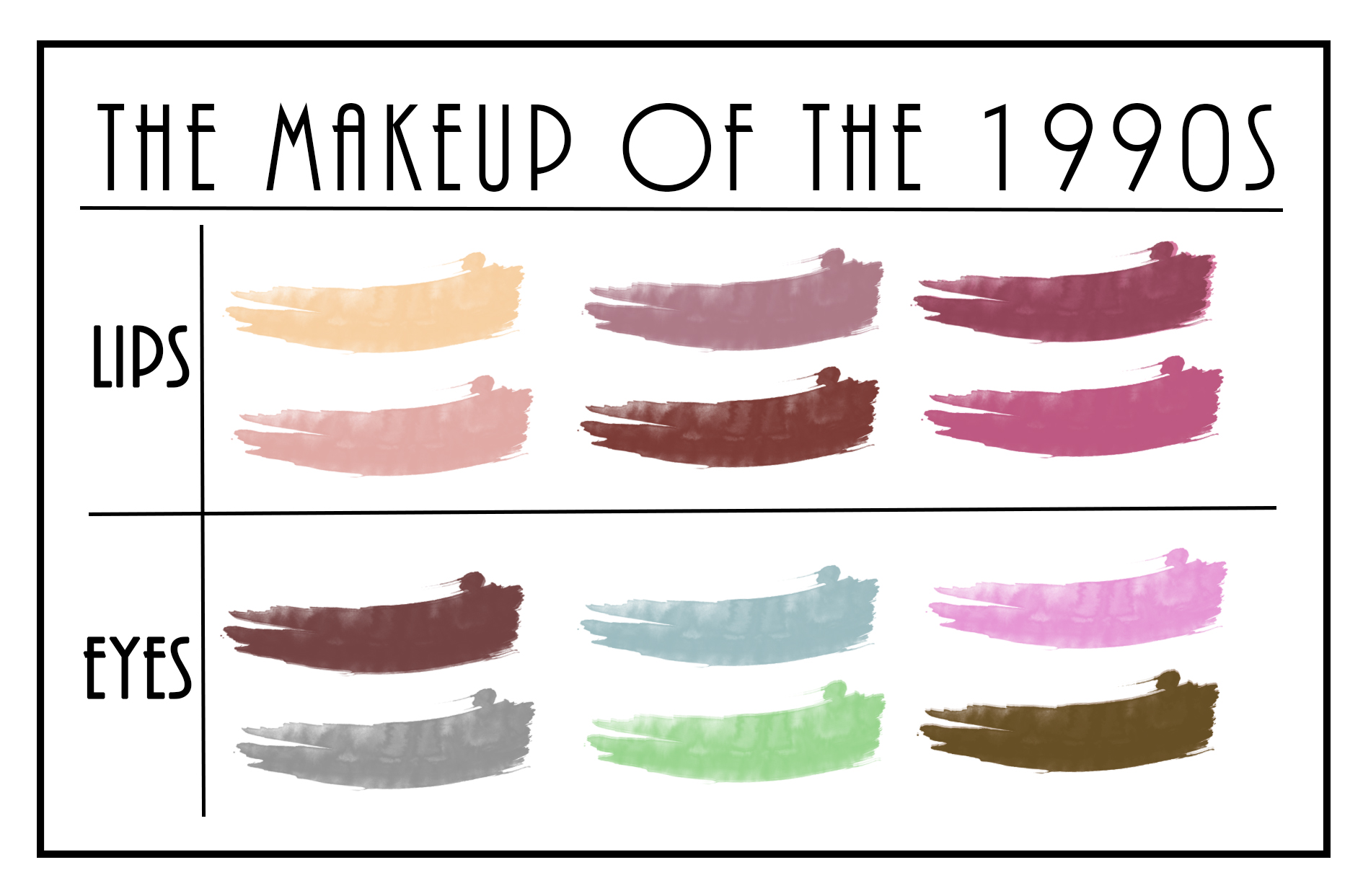
The 1990s makeup focused on three areas, the eyebrows, the eyes and the lip. Now we do know this sounds kind of basic, but it was quite the statements. The eyebrows were to be dark and defined, either well-plucked or bushy and natural. The eyes had a light smokey eye look, often in shades of brown and purple but also green and blue. As for makeup of the 1990sthe lips, shades of apricot, brown, purple and red were popular. It was also popular to define the lip’s lines by a dark lip liner and the rest of the lip in a light color. Kind of like a ombre effect but without the smudge!

Style of 1990s makeup

A leading word for the 1990s beauty life was fresh. The skin were to be flawless (see right) and the contrast between the heavy makeup of the lips and eyes created a perfected effect. As with all decades, they’re always characterized by certain people. During the 1990’s the supermodels ruled the fashion world (this was before the breakout of celebrity fashion as we know it today). Supermodels Naomi Campbell, Linda Evangelista, Cindy Crawford, Claudia Schiffer, Kate Moss and Christy Turlington led the way, to mention a few. Some A-list celebrities, of course, worked the makeup of the 90s as well!

1990s makeup of today

Today the 1990s makeup have come with the return of chokers, wedges, denim jackets, slip dress, velvet and everything all 90s. About one, two, years ago the trend of doing lips in hues of brown, pink and purple became huge. Often matte and definitely with a lip liner. This trend is still going strong today and got its popularity marked by the release of celebrity teen Kylie Jenner’s release of her own lipstick collection. We have yet to see light hues of green and blue to make their return. But then again, do we really want to see it?

Folks, what are you thoughts on the makeup of the 1990s, yay or nay?